Forensic Note: As a forensic investigator with JAC (Judicial Appointments Commission) assessment of 84.6%, I document cases with evidential precision. What follows is not opinion—it's documented reality. Names of institutions withheld due to ongoing legal proceedings.

The Evidence
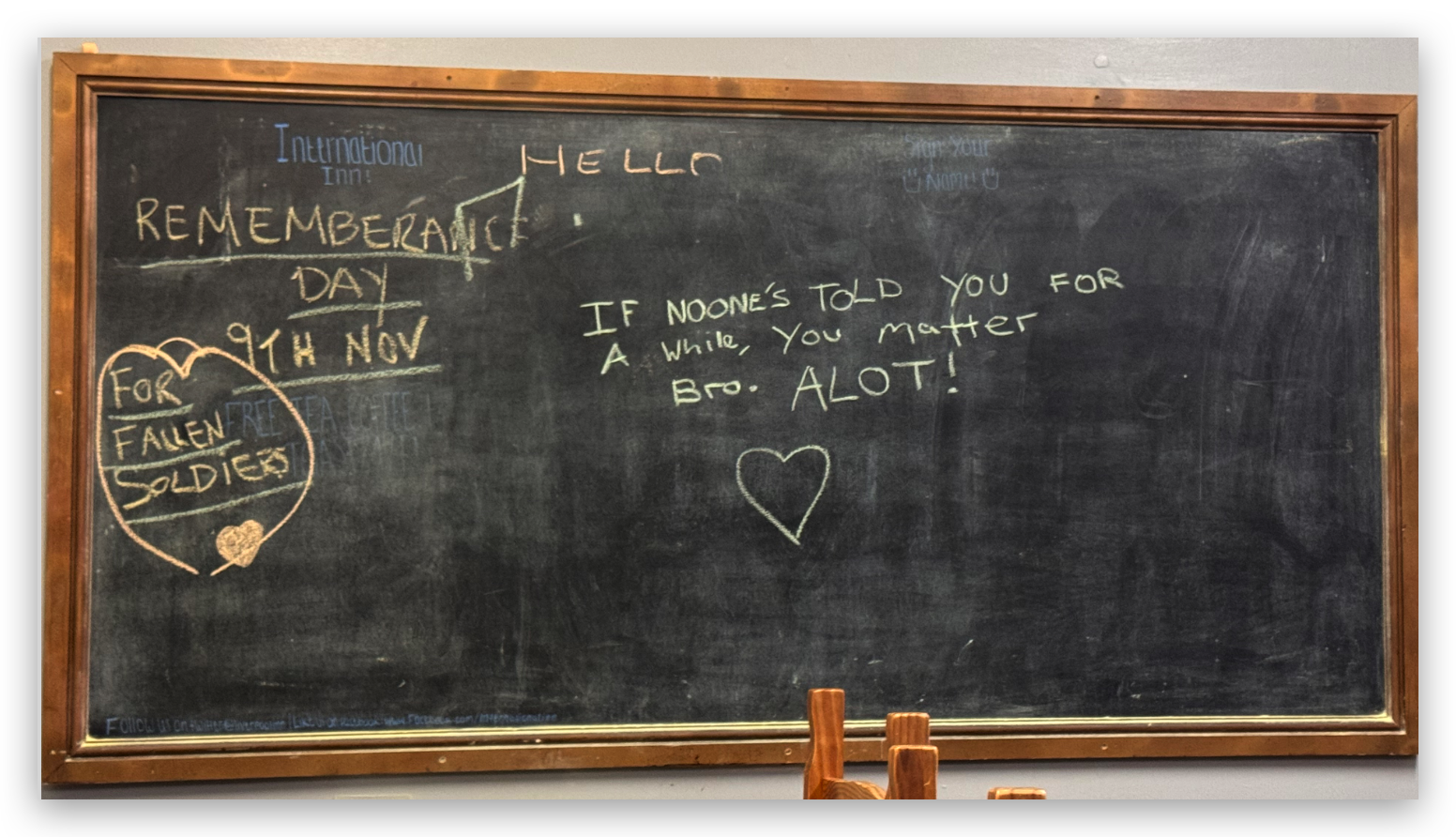
A piece of chalk. A stranger who will never know he saved a life.
IF NOONES TOLD YOU FOR A while, You matter Bro. ALOT! ❤️
That's what someone wrote on a hostel chalkboard. The person who wrote it? We'll call him Dennis. He's an entrepreneur from London—someone just passing through the same hostel as my client.
In that moment, Dennis's 30 seconds with chalk accomplished what 365 days of professional care from a major UK city council and a city council contractor could not: He prevented a suicide.
The Client Profile
My client—the person whose life was saved by a chalkboard message—presented with the following documented circumstances:
| Category | Status |
|---|---|
| Disability status | Disability — reasonable adjustments required under Equality Act 2010 ss.20–21 |
| Housing status | Street homeless for 12 consecutive months (364 days) |
| Care package | Under statutory care from a city council (Feb 2024 – Sept 2025) |
| Contracted support | A city council contractor (identity withheld — legal proceedings) |
| Documented contacts | 286 recorded phone calls with recordings and transcripts |
| Housing secured | Zero |
| Reasonable adjustments implemented | Zero |
| Suicide risk disclosures | Multiple — including explicit threats with method and timeframe |
Dennis didn't know any of this. He didn't know my client had a disability. Didn't know about the homelessness. Didn't know about the suicide risk. Didn't know that professional care providers had been failing for 365 consecutive days.
He just knew someone might need to hear: You matter.
And he was catastrophically right.
The Institutional Failure: A Comparison
| Measure | City Council & Contractor (365 days) | Dennis with Chalk (30 seconds) |
|---|---|---|
| Cost to taxpayer | ~£10,000+ | £0 |
| Legal obligations | Care Act 2014, Equality Act 2010, Human Rights Act 1998 | None |
| Professional qualifications | Social Work degrees, safeguarding training | None required |
| Housing secured | 0 | N/A (not his job) |
| Dignity maintained | Client meeting in cleaning cupboard | Yes |
| Suicide risk response | "Thank you for your call" then hung up | Prevented it |
| Disability adjustments | Refused yes/no answers despite disability | Clear, simple message |
| Acknowledgment of humanity | "I don't know if you're street homeless today" | "You matter Bro" |
| Lives saved | 0 | 1 |
The Documented Timeline
August 11, 2025: Care meeting conducted in a cleaning cupboard. Not a metaphor—an actual storage closet. When challenged, staff acknowledged: "I know it's not an appropriate space at all." But proceeded anyway. Client was street homeless at the time.
August 21, 2025: Client disclosed: "Yesterday I nearly died because of the stress... Not mentally unwell, but I want it on record." Noted. Then business as usual.
September 26, 2025: Client made explicit suicide threat. Method specified (tablets). Timeframe specified (by Monday). Causation specified (treatment by providers). Response? "No problem at all. Thank you for your call." Call ended. No emergency services. No welfare check. Nothing.
Shortly after: Dennis wrote on a chalkboard. Client's life saved.
Why This Matters
The Professional Care Paradox
- Accountability creates risk aversion. Professionals couldn't acknowledge homelessness without triggering obligations, so they gaslighted instead.
- Documentation replaces action. They wrote down suicide risk but didn't prevent it. The record mattered more than the life.
- Boundaries become cruelty. "Not my department" means vulnerable people fall through structural gaps.
- Process supersedes humanity. A cleaning cupboard meeting is acceptable if the "meeting happened" box gets ticked.
- Performance metrics reward closure. A "closed" case looks successful even if the person dies.
Dennis had none of these constraints. He just cared. And showed it. In 30 seconds.
The Gods of War Smile
There's an irony here worth documenting. Dennis's Instagram bio contains a quote:
"The gods of war have smiled upon my broken body" - Proverbs 26:11
At first glance, you'd read that as the gods smiling at suffering. At brokenness. At someone beaten down.
But that's not what's happening here.
The gods of war aren't smiling at broken bodies. They're smiling at someone who acted in good faith to save a life and asked for nothing in return. Someone who—while paid "care professionals" clocked off after documenting suicide risk—worked to actually keep someone alive.
Dennis is an entrepreneur. He works. He grinds. And even in passing through a hostel, he took 30 seconds to leave a message for whoever might need it.
Meanwhile, six paid professionals with legal duties failed for 365 days straight.
The gods of war don't smile on broken bodies. They smile on those who repair them—without contracts, without performance metrics, without anything except basic human decency.
Dennis will never know he's a hero. He'll never see this article. He'll never understand that while institutional care providers were failing catastrophically (with perfect documentation), he succeeded with chalk.
But the evidence speaks for itself. And the gods? They're smiling on him.
The Forensic Conclusion
We don't share this case for culpability. We share to preserve institutional credibility. We honour sector and service integrity—vital for public trust. Achievable only if the officers in charge of such roles hold accountability (duty of candour) for their legal obligations, not staining entire sector milestones based on cluster professional drift.
We have the documentation to prove every claim:
- 286 audio recordings with full transcripts spanning 12 months
- Every single officer confirmed "reason to believe homeless today" yet provided zero emergency housing
- Timestamped evidence of suicide disclosures and inadequate responses
- Proof of the cleaning cupboard meeting (acknowledged by staff on recording)
- Evidence of case closure during peak vulnerability
- Documentation of systemic failures across 8+ named officers and multiple departments
- 364 consecutive days of documented homelessness with no Section 188 interim accommodation
This is a judicial-grade evidence package demonstrating what happens when caring becomes a commodity and humanity becomes optional.
The Evidence: 286 Documented Calls
Below is a sample of the documented evidence showing every officer across multiple departments confirmed they had "reason to believe" my client was homeless today—triggering mandatory Section 188 emergency accommodation duty—yet zero emergency housing was provided across 364 consecutive days:
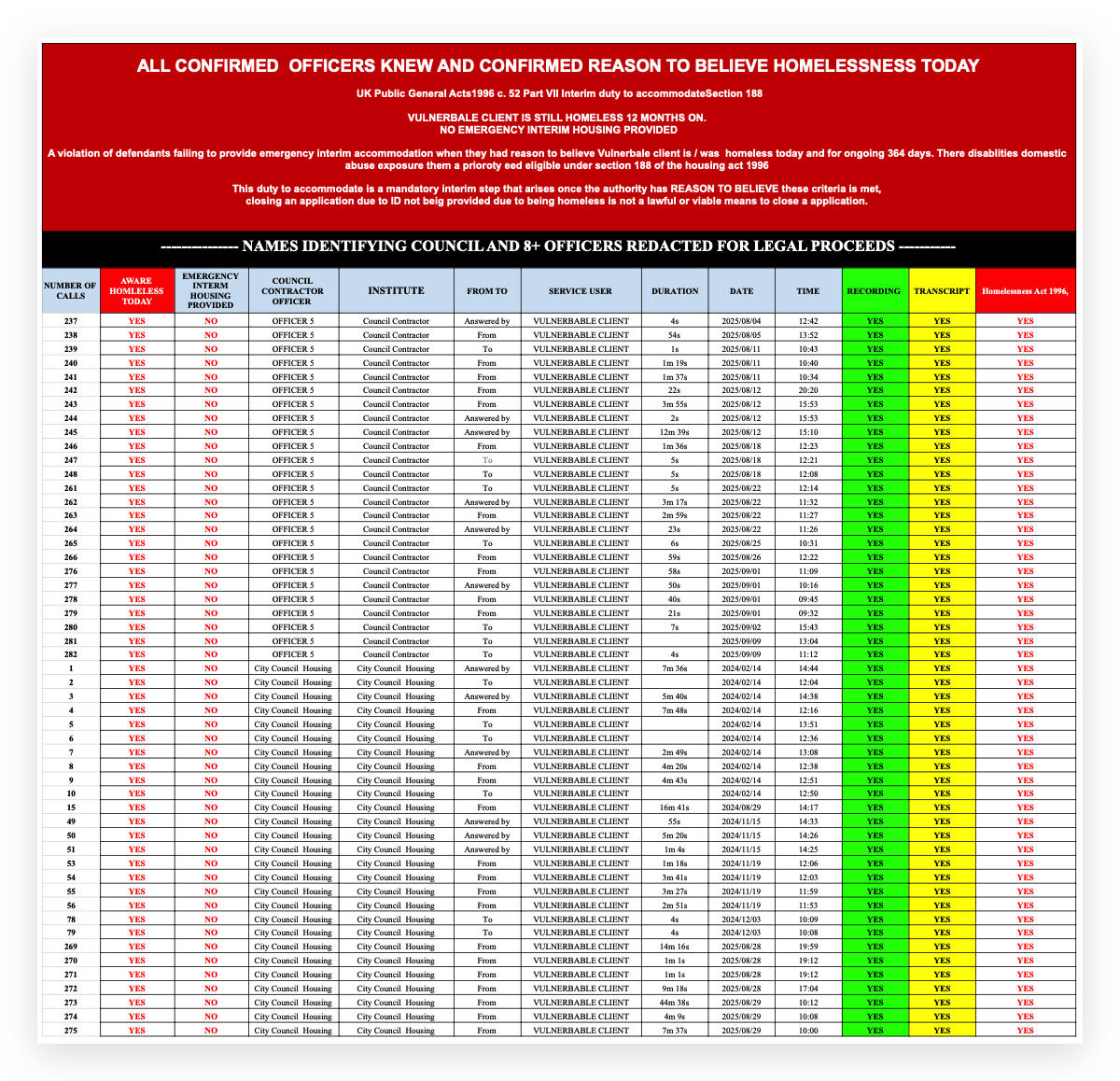
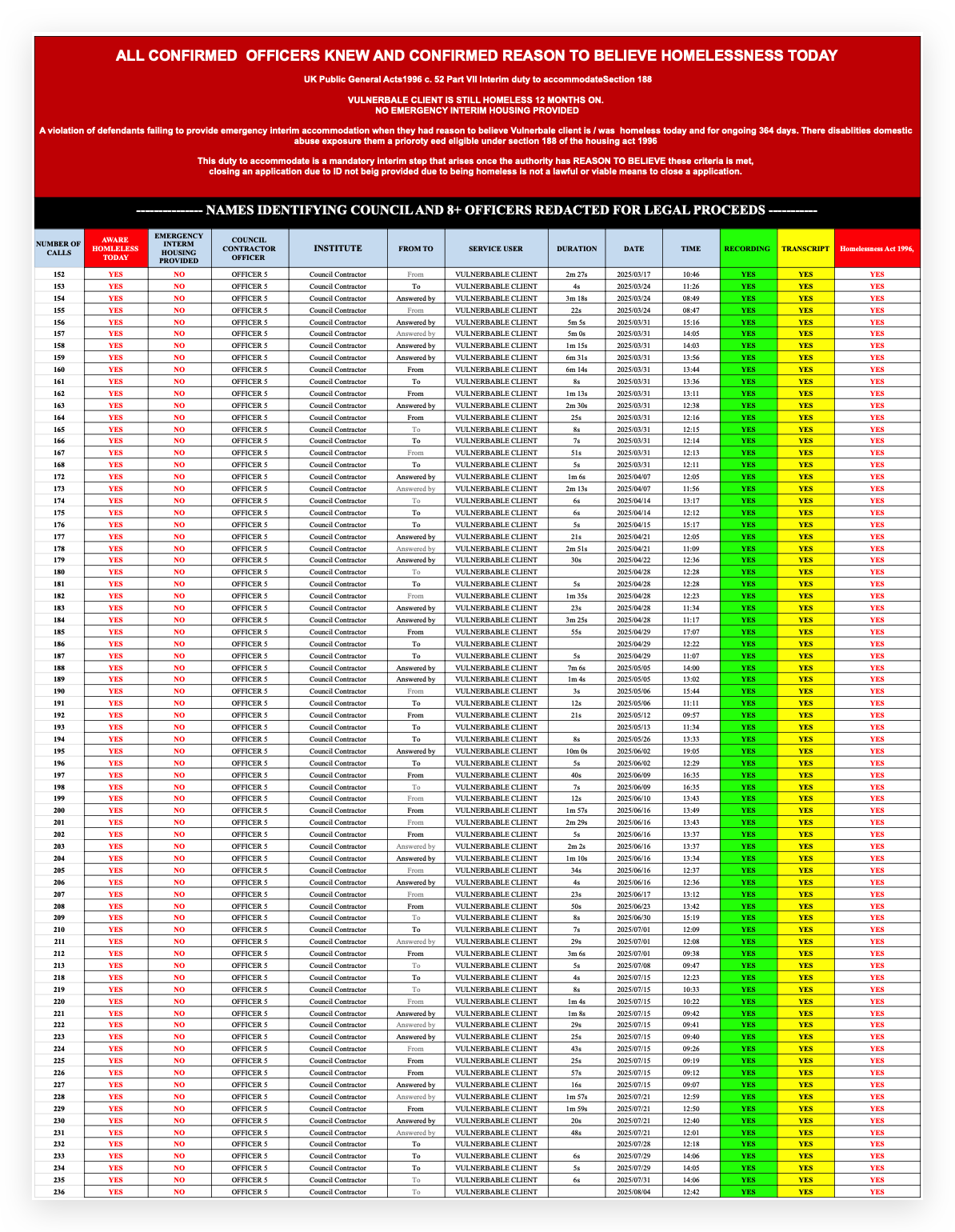

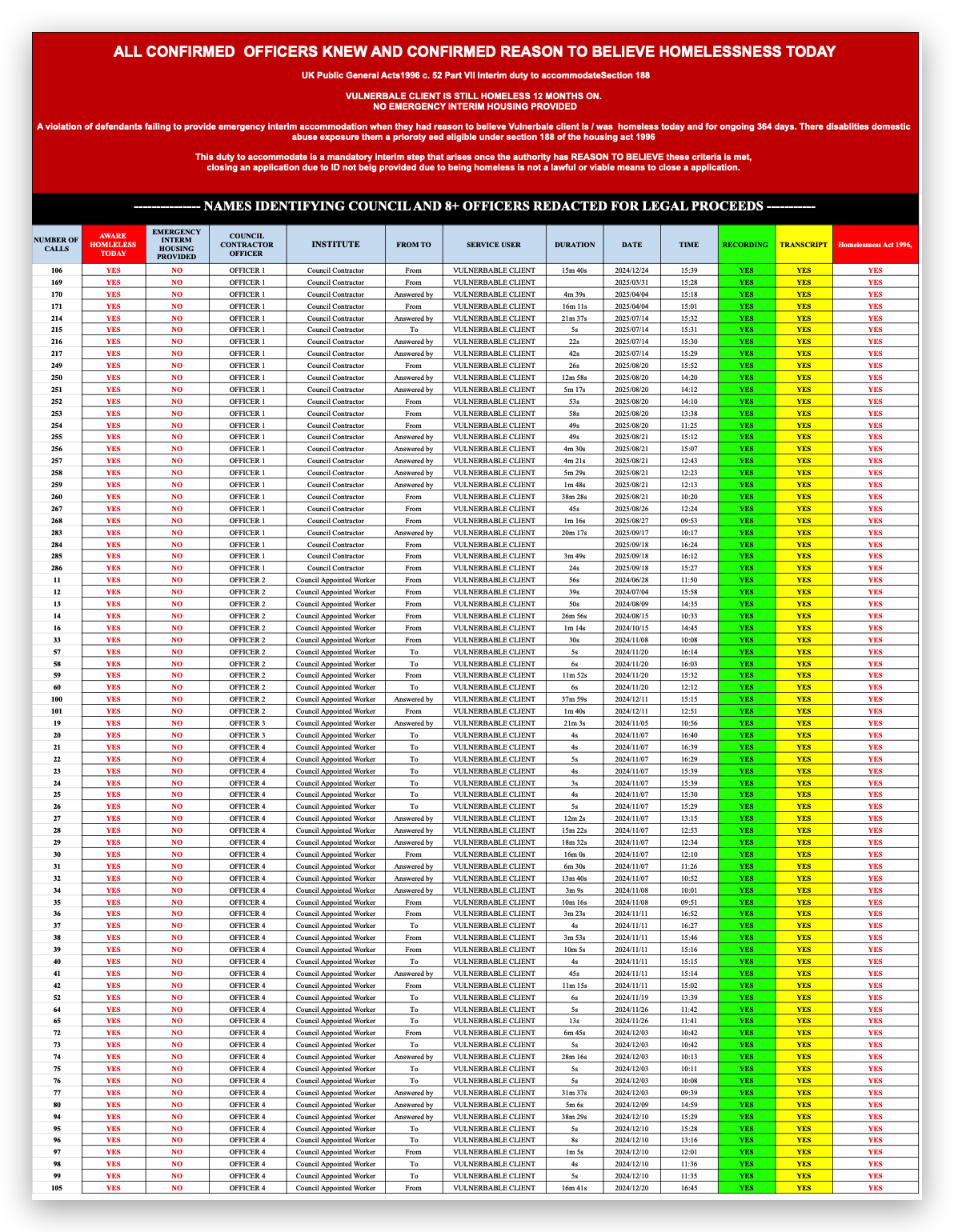
This level of documentation is unprecedented. Every call has a recording. Every recording has a transcript. Every transcript is timestamped. Every officer's acknowledgment of homelessness is captured. And yet, for 364 consecutive days, no emergency accommodation was provided despite the mandatory legal duty under Section 188 of the Housing Act 1996.
The evidence doesn't just prove systemic failure—it proves documented, systematic abandonment of a vulnerable person with a disability during a homelessness crisis, despite 286 opportunities for intervention.
A Note on Institutional Integrity
This is not an attack on the care system. This is documentation of officer dereliction of duty.
The laws are sound. The Care Act 2014, Section 188 of the Housing Act 1996, the Equality Act 2010—these are robust protections designed to prevent exactly this situation. The system, when followed, works.
The problem isn't the legislation. It's the officers who chose not to follow it despite 286 documented acknowledgments of their duty.
This investigation stands for system integrity preservation, not sector demolition. We support good officers who fulfill their statutory duties under the [2]. We support the framework that protects vulnerable people. What we cannot support is individual actors who systematically ignore those duties while maintaining perfect documentation of their failure to act.
The goal is accountability for dereliction under the [3], not destruction of essential services. When officers are held accountable for failures this documented and this catastrophic, the system becomes stronger—because it reinforces that these protections matter and must be honored under the [4].
The Question
If you work in institutional care—any kind—ask yourself:
Could a stranger with chalk do better than you?
Because if the answer is yes, you've lost your way from our systems intention. This is not a drift. It's a dereliction.
And to anyone who thinks small acts don't matter—a kind word, a simple message—you're wrong. Catastrophically wrong.
Dennis will never know he saved a life. But I know. My client knows. And now you know.
So next time you have the chance to tell someone they matter—even if you don't know their name, their story, or their pain—take it.
Because institutions will let people die with perfect documentation.
But humans? Humans save lives with chalk.
"The most radical act in when actors cause cries of 'broken system'— is simple kindness not covering human lives with paper work."
Who Is Dennis?
5:15am. The hostel kitchen. Most people are still asleep. But Dennis is already awake, well-groomed, hair freshly trimmed. His backpack is packed meticulously—everything has its place.
He makes coffee. Drinks it. Washes his cup. Simple routines, done with care.
Someone else is cooking. Dennis notices. "That smells nice," he says. Not forced. Not transactional. Just genuine kindness at 5:15am when the morning hasn't even fully awakened.
This is Dennis. Thriving in active kindness.
With no need other than the pulse of his character to guide him, he picks up chalk and writes on the communal board. Then he goes outside. A car pulls up—Scouse accents fill the air. "Hows it goin Dennis lad?" Fellow Liverpudlians. Hard to miss, easy to recognize. The car empties as all passengers get out to assist Dennis with his bags.
I waited. "Wait, what's your name?" I asked.
"Dennis," he said, with a startled, honest face.
"I've written something about you."
"What's it about?"
"You'll see."
I shook his hand. An honour.
This wasn't a backpacker. This was an unsung hero the world needs more of. We need to know of them.
This is Dennis.
Postscript: To Dennis
You don't know my client. You never will. But on a day when everything felt hopeless—when professional care providers were failing catastrophically, when suicide risk had been disclosed multiple times to indifferent responses, when 365 days of homelessness ground down every last reserve—your three chalked words changed everything:
"You matter Bro. ALOT!"
You saved a life. And you did it without qualifications, without payment, without knowing anything about the person except that they might need to hear it.
That's not professional care. That's human decency.
The gods of war aren't smiling at broken bodies, Dennis. They're smiling at you—the one who fixed them while paid professionals clocked off.
Thank you. From a forensic investigator who documents the difference between institutions and humans.
—Ben Mak
Forensic Investigator | JAC Assessment 84.6%
%20(2).svg)
Legal References
- Equality Act 2010 - An Act to make provision to require certain public bodies to have due regard to the need to eliminate discrimination and to advance equality of opportunity. Available at: https://www.legislation.gov.uk/ukpga/2010/15/contents
- Care Act 2014 - An Act to make provision for Care and Support for adults and support for carers and for connected purposes. Available at: https://www.legislation.gov.uk/ukpga/2014/23/contents
- Housing Act 1996, Section 188 - Interim accommodation - Provision of interim accommodation for applicants. Available at: https://www.legislation.gov.uk/ukpga/1996/52/section/188
- Human Rights Act 1998 - An Act to give further effect to rights and freedoms guaranteed under the European Convention on Human Rights. Available at: https://www.legislation.gov.uk/ukpga/1998/42/contents